Quick answer: An ABCDE assessment is a structured way to check an acutely unwell patient in a fixed order: Airway, Breathing, Circulation, Disability and Exposure. You assess each stage, treat any life-threatening problem before moving on, call for help early, and reassess. Resuscitation Council UK recommends this approach for every deteriorating or critically ill patient. In the NMC OSCE, the adult nursing marking criteria for the APIE assessment station include conducting an A to E assessment, so this is a skill you need to perform out loud and in order.
This guide walks through what to look for at each stage, the observations and thresholds that matter, how ABCDE links to NEWS2, and the mistakes that most often cost international nurses marks in the assessment station.
What is the ABCDE assessment and why do nurses use it?
The ABCDE approach comes from Resuscitation Council UK (RCUK) guidance on the deteriorating patient. Its value is that it puts the most immediately life-threatening problems first. An obstructed airway will kill a patient faster than a low blood pressure, and a low blood pressure faster than a high temperature. Working in this order means you never get distracted by a minor finding while a serious one goes unnoticed.
RCUK sets out a few underlying principles that apply every time:
- Do a complete initial assessment, then reassess regularly, especially after any treatment.
- Treat life-threatening problems as you find them before moving to the next letter.
- Call for help early. You do not need to finish the assessment before escalating.
- Communicate clearly using a structured tool such as SBAR. See our SBAR handover guide for examples.
Before you start: the first 30 seconds
Check the environment is safe, wash your hands, introduce yourself and confirm the patient’s identity. Then look at the patient as a whole. Do they look unwell? Ask “How are you?” A patient who answers in full sentences in a normal voice tells you their airway is open, they are breathing and their brain is being perfused. A patient who cannot answer needs your immediate attention.
If the patient is unresponsive and not breathing normally, stop the ABCDE assessment, call for help and start CPR in line with resuscitation guidelines. Our Basic Life Support training covers this in a hands-on session.
Step-by-step ABCDE assessment
A: Airway
Look, listen and feel for signs of obstruction. Warning signs include noisy breathing (stridor, gurgling, snoring), a see-saw chest and abdominal movement, use of accessory muscles, and complete silence in a patient who is trying to breathe.
What you do: call for help immediately if the airway is compromised. Use simple manoeuvres such as head tilt and chin lift, or jaw thrust, suction if there are secretions, and give oxygen as prescribed or per local emergency policy. In the OSCE, say what you are checking and what you would do: “The patient is talking to me, so the airway is patent.”
B: Breathing
Count the respiratory rate for a full minute. A normal adult rate is roughly 12 to 20 breaths per minute, and a raised rate is one of the earliest signs that a patient is deteriorating. Then check:
- Oxygen saturation (SpO2). The usual target is 94 to 98%, or 88 to 92% for patients at risk of hypercapnic respiratory failure, such as some people with COPD. Use the target set for your patient.
- Depth and pattern of breathing, and whether both sides of the chest move equally.
- Colour, signs of cyanosis, sweating, and whether the patient can speak in full sentences.
- Any added sounds you can hear, and any oxygen device already in use. Our guide to the Venturi oxygen mask explains how to deliver a set percentage of oxygen.
C: Circulation
- Look at skin colour and feel the hands. Are they warm and pink, or cool and pale?
- Check capillary refill time. Press on a fingertip for five seconds at heart level. Refill within two seconds is normal; longer suggests poor peripheral perfusion.
- Record pulse rate and rhythm, and blood pressure.
- Review fluid balance and urine output, and look for bleeding, wound drainage or other fluid losses.
Low blood pressure is often a late sign. A rising heart rate and prolonged capillary refill can show that something is wrong before the blood pressure falls.
D: Disability
- Assess level of consciousness using ACVPU: Alert, new Confusion, responds to Voice, responds to Pain, or Unresponsive. ACVPU is the scale used on the NEWS2 chart.
- Check the blood glucose. Hypoglycaemia is a common, treatable cause of confusion or reduced consciousness.
- Check pupils if appropriate, and review the drug chart for medicines that could reduce consciousness, such as opioids or sedatives.
E: Exposure
Expose the patient as needed to examine them properly, while protecting their dignity and keeping them warm. Record temperature. Look for rashes, swelling, wounds, pressure damage, drains, cannula sites showing signs of phlebitis, and calf tenderness or swelling that could suggest a deep vein thrombosis.
ABCDE at a glance
| Stage | Key checks | Red flags to escalate |
|---|---|---|
| Airway | Can they talk? Noisy breathing? Chest movement? | Stridor, gurgling, see-saw breathing, silence |
| Breathing | Respiratory rate, SpO2, chest expansion, colour | Rising rate, falling SpO2, cyanosis, cannot complete sentences |
| Circulation | Pulse, BP, capillary refill, skin, urine output | Rising pulse, refill over 2 seconds, low BP, low urine output, bleeding |
| Disability | ACVPU, blood glucose, pupils, drug chart | New confusion, responds only to voice or pain, low glucose |
| Exposure | Temperature, skin, wounds, calves, lines | Fever or hypothermia, spreading rash, hot swollen calf |
How ABCDE links to NEWS2 and escalation
Most of the observations you take during an ABCDE assessment feed straight into the National Early Warning Score 2 (NEWS2): respiratory rate, SpO2, use of supplemental oxygen, blood pressure, pulse, level of consciousness and temperature. The adult marking criteria ask you to calculate and record relevant scores accurately, so practise both together.
As a guide, the Royal College of Physicians NEWS2 framework expects a total score of 5 or more, or a score of 3 in any single parameter, to trigger an urgent clinical review, and a score of 7 or more to trigger an emergency response. Always follow the escalation policy where you work. Our NEWS2 chart guide explains scoring, Scale 2 and monitoring frequency in detail.
Using ABCDE in the NMC OSCE assessment station
The OSCE has ten stations, and four of them form the APIE scenario: assessment, planning, implementation and evaluation. The assessment station comes first, and everything that follows depends on it. If you miss a finding here, your care plan and handover will be weaker too. Read more about how the stations fit together in our OSCE 10 stations guide.
Examiners can only mark what they see and hear. A strong assessment station usually looks like this:
- Hand hygiene, introduction, identity check and consent.
- A general look at the patient and an open question about how they feel.
- A to E in order, saying each finding out loud and stating what it means.
- Observations recorded accurately on the chart, with the score calculated correctly.
- A clear statement of what you would escalate, to whom and how urgently.
- Thanking the patient, leaving them comfortable and washing your hands.
The NMC publishes the marking criteria for every field. Our guide to NMC OSCE marking criteria explains how examiners use them.
Common ABCDE mistakes in the OSCE
- Jumping to the blood pressure cuff. Candidates under pressure often start with the observation machine and skip airway and breathing. Follow the letters.
- Counting breaths for 15 seconds. A short count can produce a wrong score. Count for a full minute where you can.
- Silent assessment. Thinking a finding is not the same as stating it. Narrate what you check and what it shows.
- Forgetting glucose and capillary refill. These quick checks are easy to forget and easy marks to lose.
- No escalation. Identifying an abnormal score without saying who you would tell, and how quickly, leaves the job half done.
- Arithmetic errors on the chart. Double-check each parameter score before adding up.
A quick worked example
Mr Ahmed, 68, is on day two after abdominal surgery. He is talking but says he feels “not right”. Airway: patent, he is speaking in full sentences. Breathing: respiratory rate 24, SpO2 93% on room air, equal chest expansion. Circulation: pulse 112 and regular, BP 104/68, capillary refill 3 seconds, urine output low over the last four hours. Disability: alert, blood glucose 6.2 mmol/L. Exposure: temperature 38.4°C, wound red and tender.
Each of these findings adds to his NEWS2 score, and together they point to a patient who may be developing sepsis. The right next step is to escalate urgently to the nurse in charge or medical team using SBAR, while continuing to monitor and following local sepsis guidance. That combination of systematic assessment, interpretation and escalation is what the assessment station is designed to test.
Frequently asked questions
What does ABCDE stand for in nursing?
Airway, Breathing, Circulation, Disability and Exposure. It is the order in which you assess and treat an acutely unwell patient.
Is ABCDE the same as a primary survey?
They follow similar logic. “Primary survey” is the term usually used in trauma care, and some trauma systems add a step for catastrophic bleeding at the start. For ward patients, the RCUK ABCDE approach is the standard.
Do I need to finish ABCDE before calling for help?
No. Call for help as soon as you find a serious problem, then carry on with the assessment while you wait.
Does the NMC OSCE test the ABCDE approach?
Yes. The NMC adult nursing marking criteria for the APIE assessment station include conducting an A to E assessment, with airway, breathing, circulation, disability and exposure assessed separately.
Practise ABCDE with a clinical educator
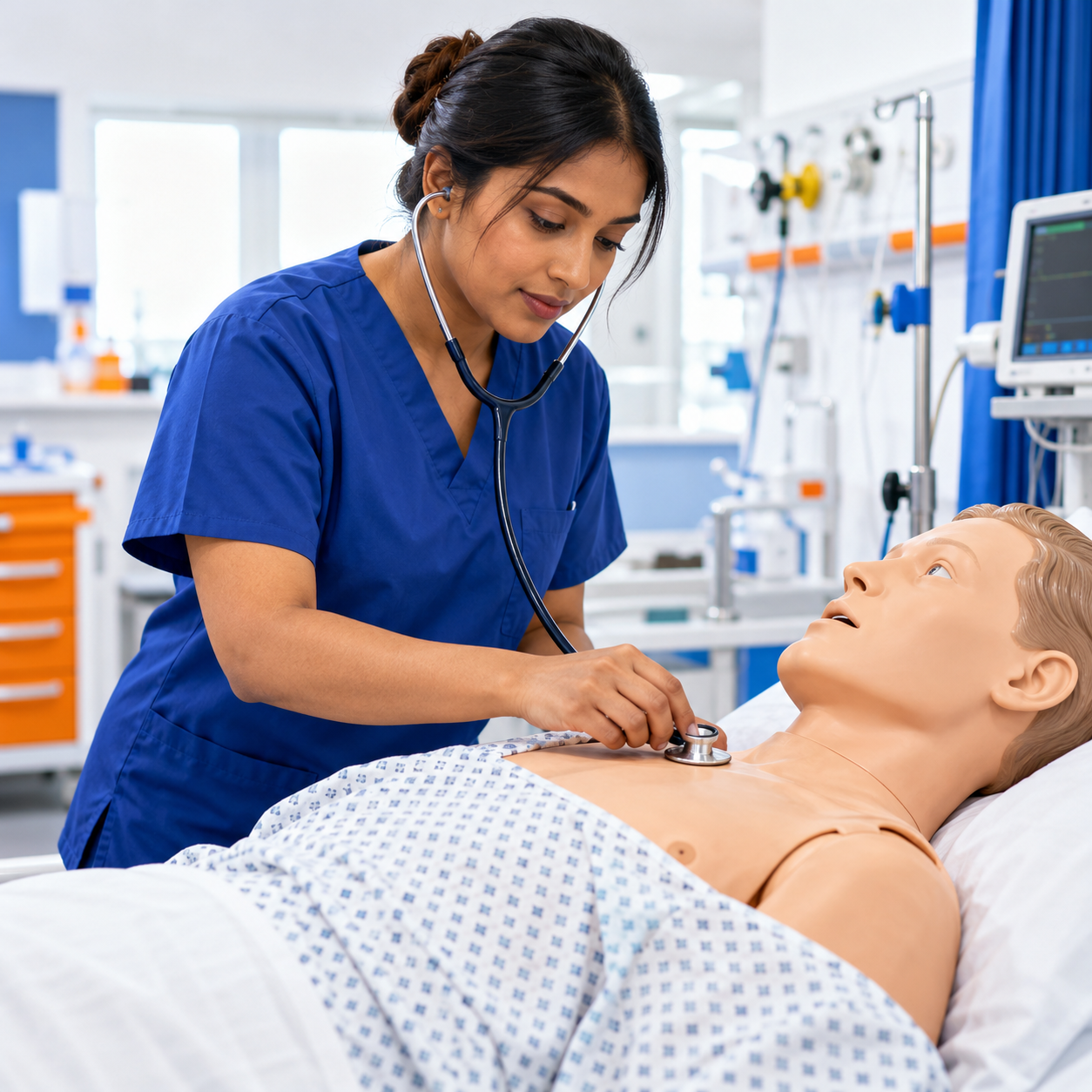
Reading the steps is the easy part. The hard part is doing them in order, out loud, with an examiner watching and a clock running. At Medax, you practise the assessment station on a manikin and with role-play patients, then get feedback on what you said, what you missed and how you scored the chart.
- Onsite adult nursing OSCE training in Harrow: hands-on practice of all ten stations.
- Virtual adult nursing OSCE training: live online sessions if you are still overseas.
- Comprehensive adult OSCE package: online preparation followed by onsite practice.
Not sure which suits you? Tell us your OSCE date and field and we will recommend a course.
Written by the Medax Group Editorial Team, who prepare international nurses for the NMC Test of Competence at our Harrow training centre. Checked on 26 November 2026 against the Resuscitation Council UK ABCDE approach and the NMC Test of Competence resources. This article supports exam preparation and general learning. In practice, always follow your employer’s policies and local escalation procedures.