
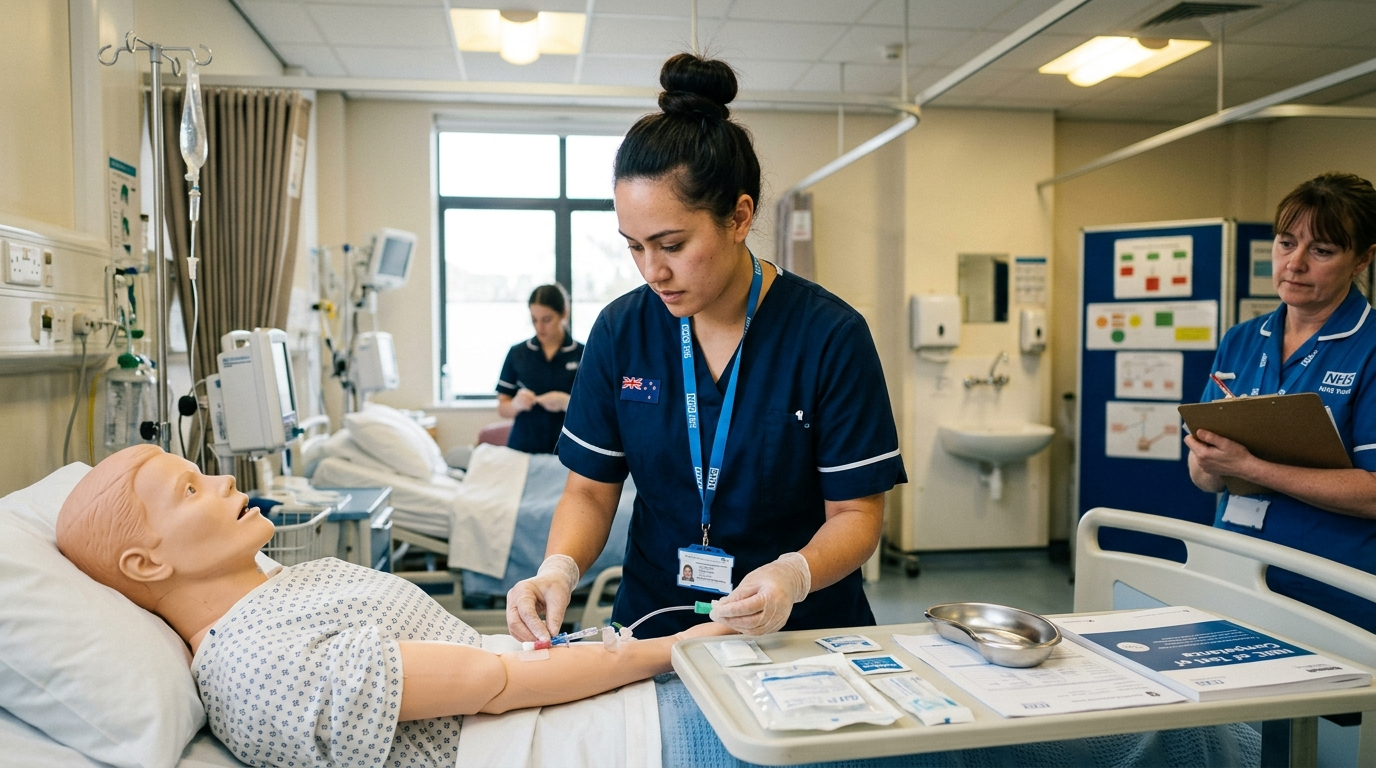
You’ve been an RN in Christchurch or Auckland for three years, you’re comfortable running a full patient load solo, and you’ve started quietly googling NHS salaries at 11pm. Then you hit the NMC website and the acronyms start piling up: ToC, CBT, OSCE, CoS. It’s not that the pathway is secretive it’s that nobody lays it out in the order you’ll actually experience it.
Here’s the part most guides skip: New Zealand nursing qualifications are not on the NMC’s list of “equivalent” jurisdictions, so even with years of solid ward experience, you’ll go through the same full Test of Competence as a nurse trained anywhere else outside the UK and EEA. That’s not a red flag on your training it’s simply how the system is structured. Once you know that going in, the rest of the process becomes a checklist rather than a mystery.
This guide walks through exactly what happens when you become a nurse in UK from New Zealand in the order the NMC actually processes it.
Do New Zealand Nurses Need to Sit the Full NMC Process?
Yes. Because your qualification was gained outside the UK and the EU/EEA, the NMC assesses you under its “trained outside the EU/EEA” route, regardless of how long you’ve been registered with the Nursing Council of New Zealand or how strong your references are. That route has four parts, and they don’t all have to happen in the order they’re listed some candidates sit their English test first, others start document verification first:
- English language evidence
- Computer-Based Test (CBT)
- Qualification and identity verification
- Objective Structured Clinical Examination (OSCE)
Step 1: Prove Your English Language Competence
Even though English is your first language and your nursing degree was taught in English, the NMC still requires formal evidence there’s no automatic exemption for New Zealand-trained nurses. You’ll need one of:
- IELTS Academic: overall 7.0, with a minimum of 6.5 in writing and 7.0 in the other three sections
- OET (Occupational English Test): three B grades plus a C+ in writing
Most New Zealand nurses we work with find OET the more natural fit, because the test uses real clinical scenarios (handovers, discharge letters, patient consultations) rather than generic academic passages. Confirm the current accepted scores directly on the OET official site before booking, since minimum grades are set and occasionally revised by the NMC.
Preparing specifically for OET’s healthcare-context format rather than treating it like a general English exam is where our OET training programme tends to save candidates a resit.
Step 2: Sit the CBT (Computer-Based Test)
The CBT is Part 1 of the Test of Competence and can be sat from New Zealand you don’t need to be in the UK yet. It’s delivered at approved Pearson VUE test centres and covers two sections in one three-hour sitting:
- Part A – Numeration (roughly 15 questions, around 30 minutes): drug calculations, fluid balance, dosage reasoning
- Part B – Clinical judgement (around 100 questions, about 2.5 hours): scenario-based questions on assessment, planning, implementation and evaluation of care, mapped to UK pre-registration standards
Book directly through Pearson VUE, and always verify the current fee and syllabus on the NMC’s registration pages before paying fees are reviewed periodically. Our CBT training programme is built around the current NMC test plan, with practice numeracy drills specifically because that section catches out experienced nurses who haven’t sat a formal exam in years.
Step 3: Submit Your Application and Get Your Qualifications Verified
While you’re preparing for or waiting on CBT results, you’ll open your NMC online account and submit:
- Your passport and identity documents
- Proof of your nursing qualification and transcript
- Confirmation of current, unrestricted registration with the Nursing Council of New Zealand
- Employer references covering recent practice
- A health and character declaration (including a police check)
The NMC contacts your training institution and the Nursing Council of New Zealand directly to verify these records. This is usually the least predictable stage timeline-wise, because it depends on how quickly outside organisations respond to the NMC’s requests build in a buffer of several months here rather than assuming a fixed turnaround.
Step 4: Sit the OSCE In the UK
Once your CBT is passed and your documents are verified, you’ll book the Objective Structured Clinical Examination at one of the NMC’s approved UK test centres. This is a full-day, in-person practical exam built around real clinical stations medicines management, clinical skills, professional values, and evidence-based practice assessed against UK pre-registration nursing standards, not New Zealand ones.
If you’re arriving on a Health and Care Worker visa tied to a job offer, you typically have a defined window from your employment start date to sit your first OSCE attempt, so it’s worth confirming your exact deadline with your sponsoring employer and on GOV.UK as soon as your Certificate of Sponsorship is issued.
This is also the stage where structured, station-by-station practice makes the biggest difference Medax OSCE Academy runs a 95% first-attempt pass rate across our cohorts, largely because we rehearse the exact APIE (Assessment, Planning, Implementation, Evaluation) structure examiners are marking against, not generic “nursing skills.” Depending on which field you registered in back in New Zealand, our Adult Nursing OSCE, Mental Health OSCE, Paediatric OSCE, or Nursing Associate OSCE tracks map to what you’ll actually sit.
Quick-Reference Checklist
- Confirm current NCNZ registration is active and unrestricted
- Sit and pass IELTS Academic or OET
- Book and pass the CBT at a Pearson VUE centre
- Open NMC online account and submit qualification, ID, references, health/character declaration
- Wait for NMC to verify documents with NCNZ and your training institution
- Secure a UK job offer and Certificate of Sponsorship (if applying for a Health and Care Worker visa)
- Book OSCE at an approved UK test centre once CBT is passed and documents verified
- Pass OSCE and receive your NMC PIN
Fees and requirements change always verify current figures on the official NMC website, OET.com, or GOV.UK before booking any test or paying any fee.
How Long Does the Whole Process Take?
There’s no single fixed timeline, and the NMC doesn’t publish a guaranteed processing time. In practice, English test results and the CBT can often be arranged within a few weeks to a couple of months since both are done from New Zealand. Document verification is the most variable stage. The OSCE typically happens after you’ve arrived in the UK, often within the first weeks of a sponsored role. Many candidates complete the full pathway within several months of starting the process, but individual cases vary based on document turnaround and test availability.
Frequently Asked Questions
Do I need a job offer before I start the NMC process?
No you can begin your English test, CBT, and document submission from New Zealand before securing a role. However, a job offer and Certificate of Sponsorship become essential once you’re ready to travel and sit your OSCE, since most candidates need a Health and Care Worker visa to enter the UK.
Is New Zealand training considered equivalent to UK training?
Not formally. The NMC’s list of qualifications it treats as broadly equivalent doesn’t include New Zealand, so NZ-trained nurses go through the full “trained outside the EU/EEA” route English test, CBT, and OSCE rather than an abridged pathway.
Can I take the OSCE in New Zealand instead of flying to the UK?
No. The OSCE is only held at NMC-approved test centres inside the UK, since it’s assessed against UK pre-registration clinical standards. The CBT and English test, by contrast, can both be completed from New Zealand.
What happens if I fail the OSCE on my first attempt?
You’re normally given further attempts within a set window, and the NMC and your visa conditions will specify the applicable timeframe. Structured re-attempt preparation focused on your specific weak stations, rather than repeating generic revision, is usually what turns a fail into a pass on the second sitting.
Does OET or IELTS expire before I finish the rest of the process?
Language test results and other Test of Competence components typically need to be completed within a set validity window set by the NMC, so it’s worth sequencing your English test relatively close to when you plan to sit CBT and OSCE rather than sitting it years in advance. Confirm current validity periods on the NMC’s English language requirements page.
If you’re mapping out your own timeline from New Zealand to an NMC PIN, our team runs free OSCE and CBT consultations to work out which track fits your field of practice and how much preparation time to build in. You can message us on WhatsApp or browse our full course list to get started.





 Get 5% OFF Any Medax Course