
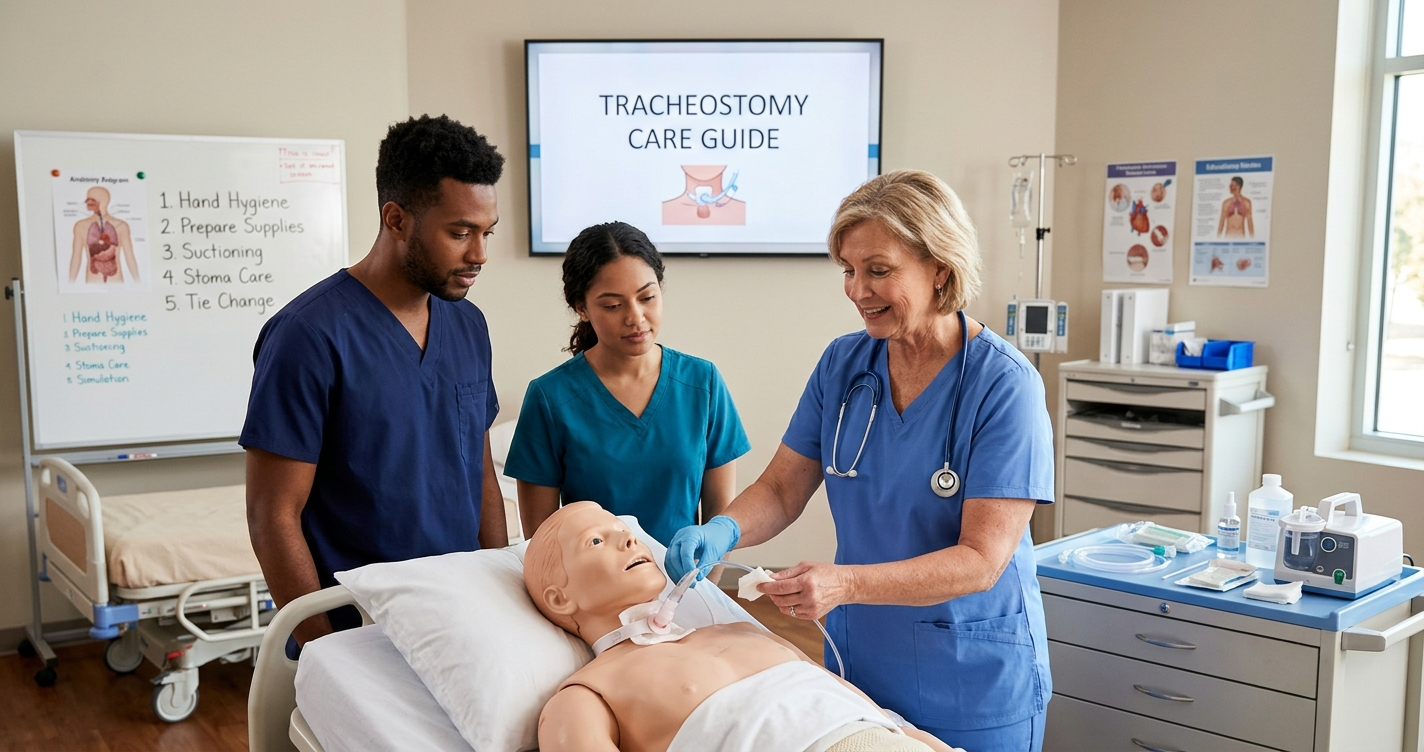
A tracheostomy is one of the highest-risk pieces of equipment a care worker will ever be responsible for. Get it wrong a blocked tube, a missed sign of infection, a fumbled emergency response and the consequences can be immediate and severe. Tracheostomy care training for care staff exists precisely because this isn’t a skill that can be safely learned from a leaflet or a single classroom session.
This guide sets out what genuine tracheostomy care training should cover, who needs it, how competency should actually be assessed, and the mistakes that most commonly put both service users and providers at risk.
What Does Tracheostomy Care Actually Involve?
A tracheostomy is a surgically created opening in the neck into the windpipe (trachea), usually with a tube in place to keep the airway open. People living with a tracheostomy in a community or supported living setting typically need support with:
- Stoma site care cleaning around the opening and checking for signs of infection or skin breakdown
- Tube changes (where the care worker is trained and signed off to assist or perform this)
- Suctioning to clear secretions and keep the airway clear
- Humidification and management of secretions, particularly important since a tracheostomy bypasses the nose’s natural warming and moistening function
- Cuff management, where a cuffed tube is in place
- Recognising and responding to emergencies a blocked tube, accidental decannulation (the tube coming out), or bleeding
Some individuals also require ventilator support alongside their tracheostomy, which adds a further layer of clinical complexity and typically demands training beyond general tracheostomy care alone.
Why This Isn’t a Skill to Learn “On the Job” Informally
A blocked or displaced tracheostomy tube can compromise someone’s airway within minutes. This is not an area where care staff should be learning through trial and error, gradually picking things up from colleagues, or relying on a single training session completed months or years earlier without refreshment.
CQC’s fundamental standards require staff to have the skills, knowledge, and experience necessary for the care they deliver. For tracheostomy care specifically, inspectors expect to see individualised, hands-on competency assessment not just a certificate confirming someone attended a session. A worker who can describe the suctioning procedure in an interview but has never been observed performing it safely under supervision has not been adequately trained, regardless of what their file says.
Core Components of Tracheostomy Care Training
1. Understanding the Anatomy and Purpose
Staff need a working understanding of why the person has a tracheostomy, what type of tube they have, and what “normal” looks like for that specific individual because tube types, cuff status, and care routines vary significantly between people.
2. Suctioning Technique
Safe suctioning depth, duration, technique, and recognising when suctioning is and isn’t appropriate delivered through supervised, hands-on <a href=”https://medax-group.com/clinical-skills-training/”>clinical skills training</a> using appropriate equipment and simulation before any real-world practice.
3. Stoma Site Care and Infection Prevention
Cleaning technique, dressing changes where relevant, and recognising early signs of infection, skin breakdown, or granulation tissue that need escalation to a clinician.
4. Humidification and Secretion Management
Understanding why humidification matters, how to use the equipment involved (heat and moisture exchangers, nebulisers where prescribed), and recognising when secretions indicate a problem rather than normal variation.
5. Emergency Response
This is the single most critical component. Staff need rehearsed, not just described, responses to:
- A blocked tube (recognising the signs and knowing the clearance protocol)
- Accidental decannulation (the tube coming out) and safe re-insertion where the worker is trained and authorised to do this, or immediate escalation where they are not
- Bleeding from the stoma site
- Signs of respiratory distress
6. Tube Changes
Not every care worker will be trained or authorised to change a tracheostomy tube this varies by provider policy, the individual’s care plan, and local clinical governance arrangements. Where care staff are involved, this requires the most intensive level of supervised practice and sign-off of any component.
Who on Your Team Needs This Training?
| Role | Typical Training Scope |
| Support Worker / Healthcare Assistant | Stoma care, suctioning, humidification, recognising and escalating emergencies |
| Senior Support Worker | All of the above, plus supervision of others and incident escalation |
| Registered Nurse (clinical oversight) | Full competency including tube changes where applicable, assessment of others, liaison with ENT/respiratory specialists |
| Bank/Agency staff | Same individualised competency standard as permanent staff before deployment |
A frequent and serious gap: bank or agency staff being deployed to support someone with a tracheostomy without their own competency being individually verified for that specific person’s equipment and care plan, on the assumption that agency-provided training is equivalent. It often isn’t, and this is exactly the kind of gap that surfaces during a serious incident review.
Online vs Onsite Training: What Actually Works
| Factor | Online / Virtual | Onsite / In-Person |
| Best for | Anatomy, theory, infection control principles, documentation standards | Suctioning technique, emergency drills, stoma care, tube change practice |
| Assessment rigour | Knowledge checks only | Direct observation and physical competency sign-off |
| Risk if used alone for practical skills | High cannot verify physical technique or reaction speed under pressure | Low assessor confirms safe, timely technique |
| Suitability for emergency response training | Poor on its own | Essential emergency scenarios need to be physically rehearsed, not just read about |
Theory can be delivered flexibly online. Suctioning technique, emergency decannulation response, and tube changes cannot be safely verified without in-person, supervised practice. Any provider offering “complete” tracheostomy training through e-learning alone is not offering a genuinely safe standard for this particular skill area. A blended model flexible theory plus mandatory in-person assessment reflects how Medax structures its <a href=”https://medax-group.com/complex-care-training/”>complex care training</a>.
Common Mistakes in Tracheostomy Care Training
Treating attendance as competency. Sitting through a session on suctioning is not the same as being observed safely performing it under time pressure.
No individualised sign-off per service user. A worker competent with one person’s tube type and routine isn’t automatically ready for a different individual with different equipment or a different baseline.
Infrequent emergency drills. Blocked tube and decannulation emergencies are, thankfully, rare for any given individual which means the skill fades without deliberate, repeated drilling, not just a single initial session.
Underestimating documentation. Precise records of secretion changes, stoma site condition, and any near-misses matter enormously for spotting deterioration early and for CQC evidence.
Assuming one refresher schedule fits everyone. Higher-risk elements (emergency response, tube changes) generally need more frequent refreshing than lower-risk elements like routine stoma cleaning.
A Realistic Scenario
Consider a composite (illustrative) example: a support worker is alone with a service user when their tracheostomy tube becomes partially blocked with a thick secretion. Untrained or under-drilled, a worker might hesitate, unsure whether to suction, reposition, or call for help first and that hesitation costs critical time.
With properly rehearsed training, the response is close to automatic: recognise the signs, attempt safe suctioning within trained limits, escalate immediately if it doesn’t resolve, and know exactly who to call and what information they need. This is the entire point of hands-on, repeated emergency drilling rather than a single classroom description of the protocol.
Costs and Time: What to Realistically Expect
Costs vary by group size, delivery format, and whether tube-change competency is included. As a general shape rather than a fixed figure:
- Theory and anatomy modules: Can typically be completed flexibly, often within a working shift via e-learning.
- Hands-on suctioning and emergency response sessions: Usually require half-day to full-day blocks with small groups, given how much individual supervised practice each person needs.
- Tube-change competency (where included): More intensive, typically requiring extended one-to-one supervised practice before sign-off.
- Refreshers: Budget for at least annual renewal on emergency response and suctioning, with more frequent informal competency spot-checks.
There’s no single flat figure that fairly represents this across every provider the right approach is mapping your specific service users’ tracheostomy needs (cuffed vs uncuffed, ventilator-dependent or not) against current staff competency, then budgeting training around the actual gaps identified. Providers reviewing options can look at Medax’s <a href=”https://medax-group.com/healthcare-training-programs/”>healthcare training programmes</a> for how this is typically structured.
What Most Guides Miss: Competency Decay Between Refreshers
Most guidance on tracheostomy training focuses heavily on the initial course. The bigger practical risk sits in the months between training events. Emergency response skills, in particular, are used rarely for any given individual, which means confidence and speed can quietly erode long before the next scheduled annual refresher.
A stronger approach and one that tends to hold up much better at inspection is folding brief, low-pressure emergency scenario walk-throughs into routine supervision every few months, rather than relying solely on an annual formal refresher. It costs very little in staff time and meaningfully closes the gap between “trained once” and “genuinely ready right now.”
How CQC Evaluates Tracheostomy Care Packages
Given the high risk involved, tracheostomy care packages tend to draw close inspection attention. Inspectors typically look for:
| Focus Area | What Strong Evidence Looks Like |
| Individualised care planning | Care plans specify the exact tube type, cuff status, suctioning parameters, and emergency contacts for each person not a generic tracheostomy template |
| Staff competency records | Task-specific sign-off per worker, per individual, dated and assessed by a named, suitably qualified assessor |
| Emergency preparedness | Evidence of regular drilling, not just an annual classroom refresher staff able to talk through the protocol confidently and specifically |
| Equipment and consumables | Spare tubes, suction equipment, and emergency kit checked and available at the point of care, not just referenced in policy |
| Escalation pathways | Clear, rehearsed understanding of who to call and when ambulance, on-call clinician, family |
Inspectors often ask staff to talk through what they would do in a specific emergency scenario during a visit. A worker who can only recite general theory, without being able to describe the specific steps for the individual they’re currently supporting, is a clear signal that training hasn’t translated into practice.
Equipment and Environment Readiness
Training alone isn’t the full picture the physical environment and equipment need to support safe care. This includes ensuring suction equipment is charged, accessible, and regularly checked; spare tracheostomy tubes of the correct size are available at the point of care, not locked away or off-site; and emergency contact information is visibly accessible rather than buried in a folder. Training that covers technique but ignores equipment readiness leaves a gap that shows up precisely when it matters most during an actual emergency.
Working Alongside Specialist Clinical Teams
Tracheostomy care in the community rarely sits with care staff in isolation. Most individuals have ongoing input from ENT or respiratory specialist teams, community nursing services, or specialist outreach teams who review the tracheostomy periodically and manage tube changes or complex complications. Training should give care staff clarity on this wider network who reviews the tracheostomy regularly, who to contact for non-emergency concerns versus genuine emergencies, and how information flows between the care team and specialist clinicians.
A common gap: care staff trained thoroughly on the physical tasks but with no clear picture of this wider clinical network, leaving them uncertain whether a change they’ve noticed warrants an urgent call or can wait for a scheduled specialist review. Building this into induction alongside the technical skills closes a gap that pure task-based training often misses.
Choosing a Training Provider for Tracheostomy Care
Given the risk involved, it’s worth being selective about who delivers this training. Questions worth asking any prospective provider:
- Do trainers have direct clinical experience with tracheostomy and airway management, not just generic complex care backgrounds?
- Is emergency response practised through realistic simulation, not just described verbally?
- Is competency assessed individually and per service user, or through a generic group pass/fail exercise?
- Does the provider offer structured refresher scheduling, or only a one-off initial session?
- Can training be tailored to the specific tube types and equipment your service users actually use?
Frequently Asked Questions
Is tracheostomy care training legally mandatory for care staff?
There’s no single named law listing every specific skill, but CQC’s fundamental standards require staff to have the skills and knowledge necessary for the care they deliver in practice, this means individualised, hands-on tracheostomy competency training wherever this need exists.
Can tracheostomy care training be completed entirely online?
Theory and anatomy content can be delivered online, but suctioning, emergency response, and tube-change skills require supervised, in-person practice before sign-off e-learning alone is not sufficient for these components.
How often should tracheostomy care training be refreshed?
Higher-risk elements like emergency response and suctioning are commonly refreshed at least annually, with more frequent informal competency spot-checks recommended given how infrequently these skills are used in day-to-day practice for any one individual.
Do agency and bank staff need the same tracheostomy training as permanent staff?
Yes. Competency should be individually verified for the specific service user’s tube type and care plan, regardless of employment status this is one of the most common gaps found during incident reviews.
Should all care staff be trained to change a tracheostomy tube?
Not necessarily. Tube-change competency is typically reserved for staff with more advanced, intensively supervised training, and provider policy and the individual’s care plan will determine who is authorised for this specific task.
What’s the biggest risk with undertrained tracheostomy care staff?
Delayed or incorrect emergency response a blocked or displaced tube can compromise someone’s airway within minutes, which is why rehearsed, hands-on emergency drilling matters as much as routine care skills.
Does completing tracheostomy training guarantee a safe outcome in every emergency?
No training can guarantee a specific outcome in a genuine emergency every situation differs. Robust, hands-on, regularly refreshed training substantially reduces risk and improves response speed and quality; it is not a guarantee.
In Summary
Tracheostomy care training for care staff isn’t a single course to tick off it’s a layered system: anatomy and theory, hands-on suctioning and stoma care practice, rigorously rehearsed emergency response, and individualised competency sign-off per service user. Providers who treat emergency drilling as a rare annual event, rather than something reinforced regularly through supervision, tend to find the gap between “trained” and “ready” widens quietly over time.
If you’re reviewing your team’s tracheostomy care readiness, start by mapping each service user’s specific equipment and needs against who on your team is genuinely, currently competent not just certified.