
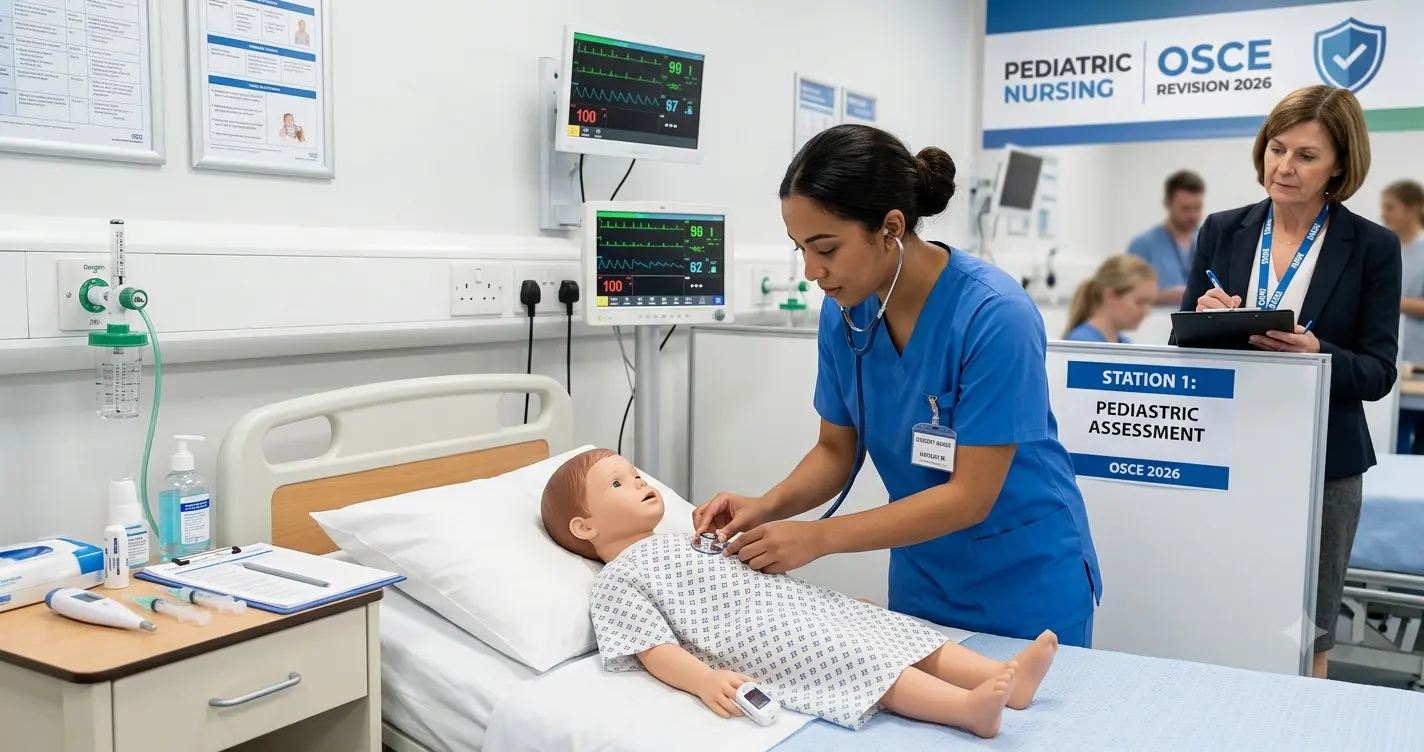
Understanding OSCE stations for children’s nursing is essential for any candidate preparing for NMC registration in 2026. Whether you are an international nurse or transitioning into UK paediatric practice, the OSCE is designed to test your ability to deliver safe, structured, and compassionate care to children in real NHS-style scenarios.
Unlike theory exams, OSCE stations are practical, timed, and highly structured. Each station evaluates not just what you know but how safely and effectively you apply it under pressure.
This guide breaks down the full list of paediatric OSCE stations, what to expect in each, and how to revise strategically to pass with confidence.
What Are OSCE Stations in Children’s Nursing?
OSCE stations in children’s nursing are structured clinical assessments used by the NMC to evaluate your competence in paediatric care.
Each station represents a real-life clinical situation, such as:
- Assessing a sick child in A&E
- Administering medication safely
- Communicating with parents or guardians
- Identifying safeguarding concerns
- Documenting clinical findings
To understand the full exam framework and preparation pathway, you can explore the official OSCE structure here:
OSCE overview and training pathway
Full List of OSCE Stations for Children’s Nursing (2026)
While exact scenarios vary, most candidates will encounter the following core station types:
1. Initial Child Assessment Station
This is one of the most common OSCE stations for children’s nursing.
You are expected to:
- Introduce yourself clearly
- Confirm child identity and parent consent
- Perform ABCDE assessment
- Recognise signs of deterioration
- Escalate if required
This station tests your ability to think like a UK paediatric nurse in an emergency setting.
For structured practice, many candidates benefit from targeted OSCE preparation programs such as:
OSCE training program for international nurses
2. Vital Signs and Clinical Observation Station
In this station, you will assess and interpret paediatric observations such as:
- Heart rate
- Respiratory rate
- Oxygen saturation
- Temperature
- Level of consciousness
You must identify abnormal trends and escalate appropriately.
Children deteriorate faster than adults, so examiners look for early recognition of red flags.
3. Medication Administration Station
This is a high-risk OSCE station for children’s nursing.
You will be assessed on:
- Weight-based drug calculations
- Safe dosage verification
- Allergy checks
- Parent communication
- Safe administration technique
Even small calculation errors can significantly impact your outcome.
To strengthen clinical accuracy, candidates often use simulation-based learning such as:
Clinical skills training for UK nurses
4. Communication with Parent/Guardian Station
This station focuses on your ability to communicate clearly and compassionately.
You must:
- Explain procedures in simple language
- Reassure anxious parents
- Involve the child appropriately
- Gain informed consent
A common failure point is focusing only on the parent and ignoring the child’s emotional needs.
5. Safeguarding Children Station
This is a critical OSCE station for children’s nursing.
You may be presented with:
- Suspicion of neglect
- Unexplained injuries
- Inconsistent parental explanations
You are expected to:
- Stay non-judgemental
- Escalate concerns immediately
- Follow safeguarding protocols
- Document accurately
This station tests your professional judgement and awareness of UK safeguarding systems.
6. Documentation Station
You will be assessed on:
- Accuracy of clinical notes
- Clear chronological order
- Use of professional language
- Confidentiality and data protection
In NHS practice, poor documentation is considered a clinical risk.
How OSCE Stations Are Structured
Each OSCE station follows a strict structure:
- Time-limited scenario (usually 8–15 minutes)
- Standardised marking checklist
- Critical safety points
- Communication assessment
- Clinical judgement evaluation
To perform well, you must use structured frameworks such as:
- ABCDE (assessment)
- SBAR (escalation)
These frameworks are essential for success in NMC assessments.
Common Mistakes in Children’s Nursing OSCE Stations
1. Lack of Structure
Candidates often fail because they jump between tasks without a clear framework.
2. Poor Communication Flow
Not addressing both child and parent reduces marks significantly.
3. Delayed Escalation
Waiting too long to escalate deteriorating conditions is a major failure point.
4. Weak Paediatric Knowledge Application
Failing to recognise red flags such as sepsis or respiratory distress.
5. Time Mismanagement
Running out of time before completing safety-critical steps.
Expert Tips to Pass OSCE Stations for Children’s Nursing
Always Start with Safety First
Hand hygiene, identification, and consent should never be missed.
Use Clinical Frameworks Automatically
ABCDE and SBAR should become second nature.
Speak While You Work
Verbalising your reasoning improves communication marks.
Prioritise Deterioration Recognition
Children can decline quickly—examiners look for early escalation.
Practice in Real Exam Conditions
Timed simulation is key to building confidence.
Many candidates improve significantly through structured OSCE environments such as:
Paediatric OSCE onsite training in the UK
Real NHS Scenario Example
A child presents with high fever, irritability, and reduced oral intake.
A strong candidate will:
- Immediately assess ABCDE
- Identify signs of possible infection
- Escalate to senior staff early
- Communicate clearly with anxious parent
- Document findings accurately
A weak candidate may:
- Focus only on history-taking
- Miss early deterioration signs
- Delay escalation
- Provide unclear communication
This difference is exactly what OSCE stations are designed to measure.
Why Understanding OSCE Stations Matters
Many candidates fail not due to lack of knowledge, but because they do not understand:
- Station expectations
- Marking structure
- UK clinical priorities
- Time pressure dynamics
Once you understand station patterns, preparation becomes significantly more efficient and targeted.
FAQs: OSCE Stations for Children’s Nursing
1. What stations come up in children’s nursing OSCE?
Common stations include assessment, medication administration, communication, safeguarding, and documentation.
2. Are OSCE stations the same every year?
Core stations remain similar, but scenarios are updated annually.
3. What is the hardest OSCE station for paediatric nursing?
Medication calculation and safeguarding stations are often the most challenging.
4. How long are OSCE stations?
Most stations last between 8 and 15 minutes depending on type.
5. Do I need UK experience to pass OSCE?
No, but understanding NHS systems improves performance significantly.
6. What causes most OSCE failures?
Poor structure, delayed escalation, and weak communication are the most common reasons.
7. How should I revise OSCE stations effectively?
Use structured frameworks and practice timed simulations repeatedly.
Conclusion
Mastering OSCE stations for children’s nursing is about more than memorising procedures it is about developing safe clinical thinking, structured communication, and confidence under pressure.
Once you understand each station type and practise them in realistic conditions, your chances of passing the NMC OSCE increase dramatically.
Book your Paediatric OSCE session today