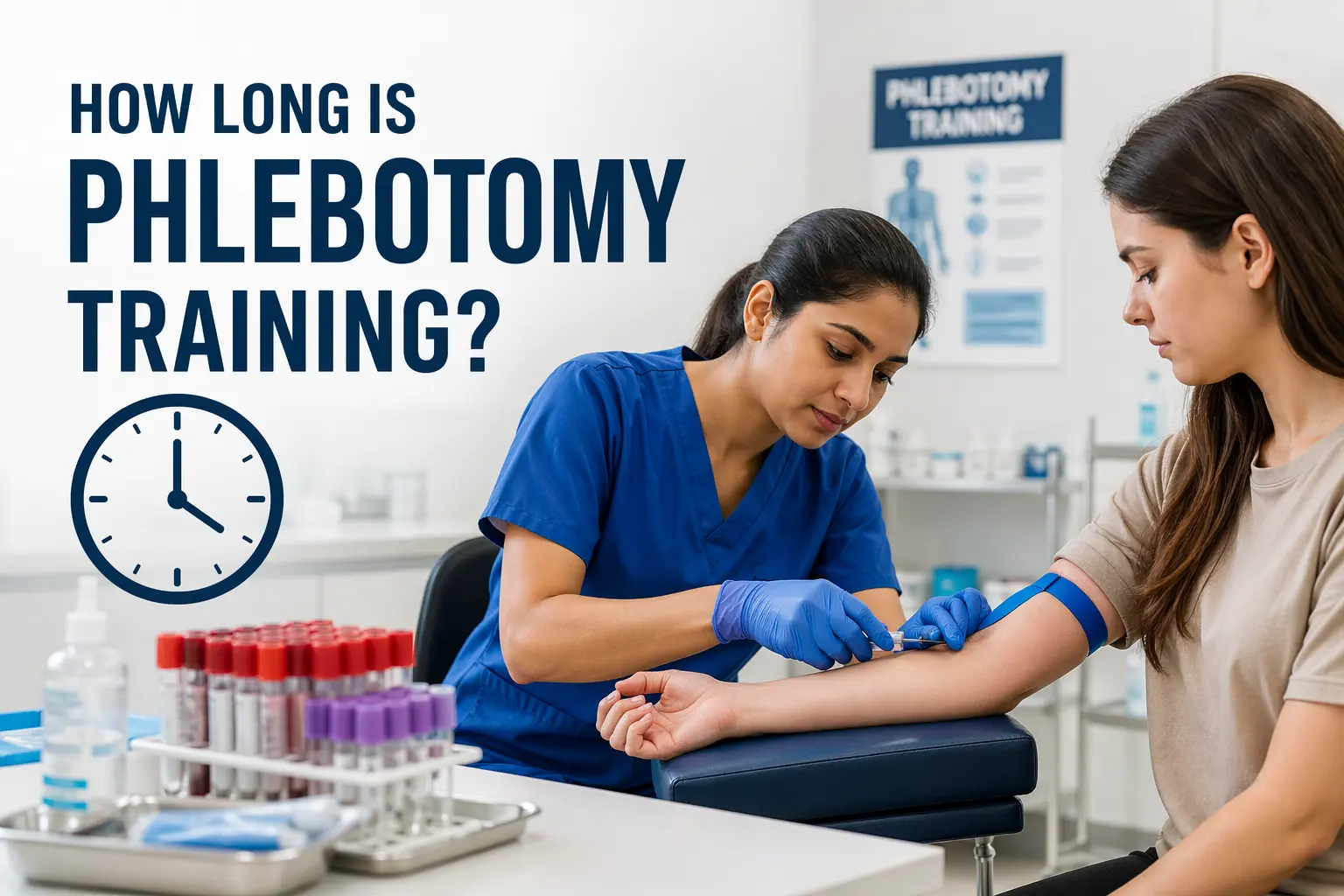
If you are asking how long does it take to become a phlebotomist, the practical answer is: you can complete basic phlebotomy training in as little as 1–2 days, but becoming confident, competent, and job-ready usually takes several weeks to 3 months, depending on the course, supervised blood-draw experience, employer requirements, and whether you are new to healthcare.
In the UK, phlebotomy is not usually a long “school” pathway like nursing. Many people enter through a short training course, a trainee phlebotomist role, healthcare assistant experience, or an apprenticeship route. The National Careers Service states that people can enter phlebotomy through college, apprenticeships, work-based progression, or direct application, and there are no fixed entry requirements for trainee phlebotomist roles, although healthcare qualifications and GCSEs can help.
For international nurses, healthcare assistants, nursing students, and UK healthcare aspirants, phlebotomy can be a useful clinical skill. It may strengthen your confidence in patient interaction, infection prevention, sample handling, and NHS-style documentation. But it is important to be clear: phlebotomy training does not replace NMC registration, CBT, OSCE, or OET/IELTS requirements for becoming a registered nurse in the UK.
This guide explains the realistic timelines, training routes, costs, common mistakes, and how phlebotomy fits into broader UK healthcare and nursing career pathways.
Quick Answer: How Long Does It Take to Become a Phlebotomist?
Most learners can complete the classroom or theory element of phlebotomy training quickly. However, safe practice depends on supervised clinical experience, not just a certificate.
| Pathway | Typical Time | Best For | What You Usually Get |
|---|---|---|---|
| Introductory phlebotomy course | 1–2 days | Beginners exploring healthcare | Theory, simulation, basic practical exposure |
| Short course with supervised live blood draws | 2 days to 4 weeks | Job-ready beginners | Certificate of attendance or competency, depending on provider |
| Competency-based programme | 8–12 weeks | Learners needing stronger clinical practice | Supervised venepuncture, assessment, competency sign-off |
| NHS trainee phlebotomist role | Varies by employer | People applying directly to NHS jobs | On-the-job training and supervised practice |
| Healthcare assistant to phlebotomist route | 1–6 months | HCAs upgrading their role | Employer-led training plus ward or clinic experience |
A public NHS phlebotomy training course, for example, states that its course lasts two days, with theory, dummy-arm practice, and supervised patient bleeding, while a competency-based course from Synnovis describes up to 90 clinical practice hours completed within a 12-week period.
So, when people search how long does it take to be a phlebotomist, the honest answer is:
Training can be short, but competence takes supervised practice.
What Does a Phlebotomist Actually Do?
A phlebotomist collects blood samples from patients and sends them for testing. This sounds simple, but the role carries clinical responsibility.
A phlebotomist may:
- Confirm patient identity.
- Explain the procedure and gain consent.
- Select suitable equipment.
- Apply infection prevention procedures.
- Perform venepuncture safely.
- Label samples accurately.
- Manage fainting, anxiety, pain, or difficult veins.
- Complete records and send samples to the correct laboratory pathway.
The National Careers Service describes phlebotomists as professionals who collect blood samples for analysis and testing, with typical duties including explaining procedures, inserting a needle into a vein, applying dressings, labelling samples, and completing records.
This is why good training must go beyond “how to insert a needle.” A safe phlebotomist understands patient dignity, infection control, documentation, escalation, and clinical governance.
For learners who want broader practical healthcare preparation, Medax’s clinical skills training can support development of hands-on clinical confidence: https://medax-group.com/clinical-skills-training/
How Long Is Phlebotomy School?
In the UK, the phrase “phlebotomy school” can be misleading. Unlike nursing, medicine, or midwifery, phlebotomy does not normally require years of university study.
Most UK phlebotomy training is delivered through:
- Private healthcare training providers.
- NHS trust training departments.
- College health and social care routes.
- Apprenticeships.
- Employer-led training after recruitment.
- Healthcare assistant upskilling.
The NHS careers guidance says there are no specific entry requirements for phlebotomy, although GCSEs or equivalent qualifications may help, and trainee phlebotomists usually receive training on the job.
That means phlebotomy school can be as short as a weekend course, but your ability to work independently depends on whether your employer accepts your training and whether you have enough supervised experience.
Certificate of Attendance vs Certificate of Competence
This is one of the biggest things most blogs fail to explain.
A certificate of attendance means you attended the course. It does not always prove that you can safely take blood from real patients.
A certificate of competence usually means you have been assessed against a practical standard. This may include supervised blood draws, documentation checks, infection control practice, and trainer sign-off.
When choosing a course, ask:
- Will I practise on a simulation arm only, or real patients under supervision?
- How many successful supervised blood draws are required?
- Is there a competency assessment?
- Is DBS or occupational health clearance needed?
- Will employers recognise the certificate?
- Does the course include infection prevention, consent, sample labelling, and complications?
A fast course is not automatically a bad course. But a fast course without supervised practice is usually not enough for real clinical confidence.
How Long Does Phlebotomy Certification Take?
Phlebotomy certification can take from 1–2 days to around 12 weeks, depending on the provider and the level of supervised practice.
Here is the realistic breakdown:
| Certification Type | Time Needed | Strength | Limitation |
|---|---|---|---|
| Attendance certificate | 1 day | Fast introduction | May not prove live-patient competence |
| Theory + simulation certificate | 1–2 days | Useful for beginners | Limited real-patient exposure |
| Supervised practical certificate | 2 days to 4 weeks | Better for job applications | Availability depends on live-patient sessions |
| Competency-based certificate | 8–12 weeks | Strongest for clinical confidence | Takes longer and may cost more |
A two-day course may be enough to start applying for entry-level phlebotomy or trainee posts if it includes supervised practice and is accepted by employers. A longer competency programme may suit learners who are nervous, new to healthcare, or planning to work in a busy clinical environment.
The safest way to think about this is:
Certification is not the final goal. Competence is the goal.
Can You Become a Phlebotomist With No Healthcare Experience?
Yes, many beginners can train in phlebotomy without previous healthcare experience. However, healthcare experience helps.
If you have never worked with patients before, you may need more time to become comfortable with:
- Speaking to anxious patients.
- Maintaining privacy and dignity.
- Following infection control procedures.
- Documenting accurately.
- Managing sharps safely.
- Recognising when to stop and escalate.
A beginner may complete the course in 2 days but still need several weeks of practice before feeling job-ready.
If you already work as a healthcare assistant, support worker, nursing student, laboratory assistant, or overseas nurse, you may progress faster because you already understand patient communication, confidentiality, basic anatomy, and clinical routines.
For healthcare assistants who want to expand into broader care skills, Medax’s healthcare training programmes may be a useful next step: https://medax-group.com/healthcare-training-programs/
Step-by-Step: How to Become a Phlebotomist in the UK
Step 1: Understand the Role Before Paying for a Course
Phlebotomy is patient-facing. It requires calm communication, attention to detail, and strict procedure.
You should be comfortable working with blood, needles, vulnerable patients, and laboratory processes. If you are unsure, start with healthcare volunteering, healthcare assistant exposure, or a short introductory course.
Step 2: Choose the Right Training Route
You can enter through:
- A short phlebotomy course.
- A trainee phlebotomist job.
- A healthcare assistant role with phlebotomy training.
- A healthcare science assistant apprenticeship.
- A college health and social care course.
The National Careers Service lists college, apprenticeship, work-based, and direct-application routes, and also notes that an apprenticeship may involve a Healthcare Science Assistant Level 2 or Healthcare Support Worker Level 2 route.
Step 3: Check Whether You Need DBS and Occupational Health Clearance
Many clinical environments require DBS checks, immunisation evidence, and occupational health clearance before live patient contact.
This is especially relevant if your course includes supervised blood draws.
Step 4: Complete Theory and Simulation Practice
A strong course should cover:
- Anatomy of veins.
- Patient identification.
- Consent.
- Infection prevention and control.
- Sharps safety.
- Tourniquet use.
- Order of draw.
- Sample bottles.
- Labelling.
- Complications.
- Documentation.
- Waste disposal.
- Professional boundaries.
Simulation arms are useful, but they are not a full substitute for supervised patient experience.
Step 5: Complete Supervised Blood Draws
This is where confidence develops.
You learn how to handle real variation: rolling veins, anxious patients, elderly skin, dehydration, fainting, failed attempts, and communication under pressure.
A course that includes supervised live blood draws is usually stronger than a course that only includes classroom theory.
Step 6: Apply for Jobs or Internal Upskilling
Common job titles include:
- Trainee phlebotomist.
- Phlebotomist.
- Healthcare assistant with phlebotomy.
- Clinical support worker.
- Pathology support worker.
- Healthcare science assistant.
Some employers train you after hiring. Others prefer previous healthcare or phlebotomy experience.
Step 7: Keep Learning After Your First Role
Once employed, you may progress toward:
- Senior phlebotomist.
- Team leader.
- Healthcare assistant with extended skills.
- Clinical support worker.
- Nursing associate pathway.
- Nursing degree route.
- Overseas nurse NMC registration, if already qualified as a nurse.
The National Careers Service notes that experienced phlebotomists may progress into senior phlebotomist, team leader, or manager roles.
How Much Does Phlebotomy Training Cost?
UK phlebotomy course prices vary widely. Short courses may cost a few hundred pounds. NHS or hospital-based programmes with live clinical practice may cost more.
Your budget should include:
| Cost Item | What to Expect |
|---|---|
| Course fee | Often a few hundred pounds, depending on provider |
| DBS check | May be included or separate |
| Occupational health | May be required for live patient practice |
| Travel | Important if clinical practice is at a hospital site |
| Uniform or PPE | Usually provider-specific |
| Lost work time | Especially for weekday courses |
| Further training | Needed if moving into HCA, OSCE, CBT, or nursing route |
One NHS trust public course lists a two-day phlebotomy training programme costing £600, including theory and practical elements.
Do not choose purely by price. A low-cost course with no supervised practice may be less useful than a more structured programme that includes live-patient competency assessment.
Online vs Onsite Phlebotomy Training
Online learning can teach theory. It cannot fully teach venepuncture competence.
| Training Type | Pros | Cons | Best For |
|---|---|---|---|
| Online theory | Flexible, cheaper, good for preparation | No hands-on skill assessment | Learners reviewing anatomy, safety, and procedure |
| Onsite simulation | Practical equipment exposure | May still lack real patients | Beginners needing confidence |
| Onsite supervised live practice | Strongest for competence | More expensive, less flexible | Job-ready learners |
| Employer-led training | Directly aligned to workplace policy | Requires getting the role first | Trainee phlebotomists and HCAs |
For phlebotomy, onsite practice matters because the skill involves touch, pressure, angle, patient response, and judgement. You need feedback from a competent trainer.
What Most People Miss About Phlebotomy Training
1. The Needle Is Not the Hardest Part
The hardest part is often clinical judgement.
Should you proceed if the patient looks faint? What if the patient refuses? What if the vein collapses? What if the label does not match the request form? What if the patient is confused?
Good training prepares you to stop safely, escalate, document, and protect the patient.
2. Labelling Errors Are Serious
A technically perfect blood draw can still be unsafe if the sample is mislabelled.
Patient identification and sample labelling are core safety skills. In real healthcare environments, wrong patient samples can lead to wrong diagnosis, wrong treatment, or delayed care.
3. One Failed Attempt Does Not Mean You Are Bad
New learners often lose confidence after failed attempts. This is normal.
Competence develops through supervised repetition, reflection, and trainer feedback.
4. Phlebotomy Is Not the Same as Cannulation
Phlebotomy means taking blood. Cannulation means inserting a cannula, usually for intravenous access. They are related but not the same. Do not assume one certificate covers both.
5. A Certificate Does Not Guarantee a Job
A good certificate can strengthen your application, but employers still assess experience, communication, right to work, references, DBS, and local competency.
A public NHS course explicitly states that completing its course does not guarantee employment in that department or elsewhere.
Phlebotomy for International Nurses: Where It Fits in the UK Journey
Many internationally educated nurses from India, Pakistan, Nepal, Nigeria, Ghana, Kenya, Zimbabwe, the Philippines, and other regions search for phlebotomy training because they want UK clinical exposure before or during the NMC pathway.
This can be useful, but it must be placed correctly.
Example Journey: CBT → OSCE → UK Job
Consider a typical internationally educated adult nurse.
She has hospital experience in India and wants to work in the UK. She begins with English preparation through OET or IELTS, completes NMC eligibility steps, studies for CBT, applies for UK nursing roles, relocates after sponsorship, and prepares for OSCE in the UK.
In that journey, phlebotomy may help her with:
- Patient communication.
- Infection prevention habits.
- Consent and dignity.
- Sharps safety.
- Confidence in clinical environments.
- Understanding UK documentation expectations.
But phlebotomy does not replace the NMC Test of Competence. For overseas nurses and midwives, the NMC Test of Competence includes a CBT and OSCE, and candidates must pass the test specific to their register field, such as adult nursing, mental health nursing, children’s nursing, midwifery, or nursing associate.
International nurses planning their UK registration can read Medax’s NMC registration guide: https://medax-group.com/a-step-by-step-guide-to-nmc-registration-process/
How Phlebotomy Compares With CBT, OSCE, and OET
Phlebotomy is a clinical skill. CBT, OSCE, and OET are professional registration or language milestones.
| Area | Purpose | Typical Candidate | Time Pressure | Outcome |
|---|---|---|---|---|
| Phlebotomy | Learn safe blood collection | HCAs, beginners, nurses, clinical support staff | Days to weeks | Skill certificate or competency |
| CBT | Test nursing or midwifery knowledge | International nurses/midwives | 3-hour exam | NMC Test of Competence Part 1 |
| OSCE | Test practical UK clinical competence | International nurses/midwives | Timed stations | NMC Test of Competence Part 2 |
| OET/IELTS | Prove English language ability | International applicants | Exam-based | English evidence for NMC |
For nurses and midwives, the NMC CBT has Part A for numeracy and Part B for clinical questions. Part A is 15 questions in 30 minutes, while Part B is 100 questions in 2 hours 30 minutes. The current fee for sitting both CBT parts is £83.
For English language evidence, the NMC currently accepts IELTS Academic scores of Listening 7, Reading 7, Writing 6.5, Speaking 7, or OET scores of B in Listening, Reading and Speaking, and C+ in Writing, subject to the NMC’s validity and combining rules.
For CBT preparation, Medax provides CBT training support: https://medax-group.com/cbt/
For OET preparation, learners can explore Medax OET training: https://medax-group.com/oet/
OSCE Structure: What International Nurses Must Understand
If you are an international nurse, the OSCE is usually more demanding than a short clinical skills course because it assesses UK-ready practice, not just isolated tasks.
The NMC OSCE for nurses and midwives has 10 stations. Four stations are linked around APIE: Assessment, Planning, Implementation, and Evaluation. Four stations test skills in two pairs. Two stations assess values and behaviours and evidence-based practice.
The OSCE is not just about “doing the skill.” It assesses whether you can practise safely according to UK expectations.
OSCE Timing
Current NMC station timing documents show many nursing APIE scenarios use:
| APIE Station | Typical Duration |
|---|---|
| Assessment | 20 minutes |
| Planning | 14 minutes |
| Implementation | 15 minutes |
| Evaluation | 8 minutes |
Skills stations vary. For example, adult nursing skills listed in current NMC timing materials include durations such as 6, 8, 10, 12, 14, or 21 minutes, depending on the station. Evidence-Based Practice and Professional Values stations are listed as 10 minutes.
This is why OSCE preparation must include:
- Timed practice.
- UK documentation.
- Escalation language.
- Infection prevention.
- Professional communication.
- Evidence-based reasoning.
- Patient dignity.
- Reflection and feedback.
For structured OSCE preparation, Medax’s OSCE training programme is the most relevant pathway: https://medax-group.com/osce-training-program/
Adult nursing candidates can explore OSCE virtual adult nursing: https://medax-group.com/osce-virtual-adult-nursing/
Learners who prefer in-person support can review OSCE onsite adult nursing: https://medax-group.com/osce-onsite-adult-nursing/
Candidates who need a more complete preparation route can consider OSCE comprehensive adult nursing: https://medax-group.com/osce-comprehensive-adult-nursing/
NMC Registration Costs and Timelines: What International Nurses Should Budget For
Phlebotomy training may cost a few hundred pounds, but NMC registration is a separate professional pathway.
For internationally trained applicants, the NMC lists core costs including a £140 qualification evaluation fee, £83 CBT fee, £794 OSCE fee, and £153 registration fee, making £1,170 before possible resits, English tests, travel, visa, accommodation, or training costs.
| Stage | Current Core Cost |
|---|---|
| Qualification evaluation | £140 |
| CBT | £83 |
| OSCE | £794 |
| Registration entry fee | £153 |
| Core total | £1,170 |
The NMC also states that CBT and OSCE must be passed within two years of each other, and once both are passed, the Test of Competence remains valid for five years.
This matters because many international nurses underestimate timing. You are not only preparing for exams. You are also managing documents, employer interviews, visa timelines, relocation costs, family decisions, and adaptation to UK clinical practice.
Medax’s guide on what happens after CBT may help candidates plan the next stage: https://medax-group.com/after-cbt-guide-nmc-osce-2025/
Phlebotomy vs Nursing in the UK: Do Not Confuse the Pathways
Phlebotomy can help you enter healthcare, but it does not make you a registered nurse.
| Goal | Required Route |
|---|---|
| Work as a phlebotomist | Training, competency, employer acceptance |
| Work as a healthcare assistant | Employer recruitment, care training, DBS, induction |
| Work as a UK registered nurse | NMC registration, English evidence, CBT, OSCE, health and character checks |
| Work as a nursing associate | Specific training or NMC nursing associate route |
| Progress into nursing degree | University entry, apprenticeship, or approved nursing programme |
If you are an international nurse, your priority should remain NMC registration. Phlebotomy can support clinical confidence, but it should not delay CBT, OET, or OSCE preparation unless you need time to build foundational UK care skills.
For broader UK nursing career planning, Medax’s UK nursing journey guide is relevant: https://medax-group.com/start-your-professional-nursing-journey-in-the-uk/
Common Mistakes That Delay Phlebotomy and Healthcare Career Progress
Mistake 1: Choosing the Shortest Course Without Checking Clinical Practice
A one-day theory course may be useful, but it may not be enough for employment.
Check whether the course includes live patient practice, assessment, and competency sign-off.
Mistake 2: Assuming All Certificates Are Equal
Employers decide what they accept. A CPD certificate, attendance certificate, and competency certificate may carry different weight.
Mistake 3: Ignoring Communication Skills
Patients may be anxious, elderly, in pain, confused, or needle-phobic. The best phlebotomists are calm, clear, and respectful.
Mistake 4: Weak Infection Control Habits
Hand hygiene, PPE, sharps disposal, surface cleaning, and safe sample handling must become automatic.
Mandatory care training can support healthcare workers who need stronger grounding in workplace safety and care standards: https://medax-group.com/mandatory-care-training/
Mistake 5: International Nurses Treating Phlebotomy as an OSCE Substitute
OSCE is wider and more demanding. It assesses professional values, evidence-based practice, communication, planning, implementation, evaluation, and UK standards.
OSCE candidates should follow a dedicated OSCE route rather than relying only on general clinical skills practice: https://medax-group.com/osce/
How to Choose the Right Phlebotomy Course
Use this checklist before enrolling.
| Question | Why It Matters |
|---|---|
| Does the course include live supervised blood draws? | Builds real competence |
| How many successful bleeds are required? | Shows depth of practice |
| Is there a practical assessment? | Confirms skill level |
| Is DBS required? | Often needed for patient contact |
| Is occupational health clearance needed? | Important for clinical settings |
| Who teaches the course? | Trainer experience matters |
| Is sample labelling covered? | Critical for patient safety |
| Is infection control assessed? | Essential in UK healthcare |
| Is the certificate attendance-based or competency-based? | Affects employer value |
| Does the provider make realistic job claims? | Avoids false expectations |
A trustworthy provider will explain limitations clearly. Be cautious with any course that promises instant employment, guaranteed NHS jobs, or professional registration from a short certificate.
Career Outcomes After Phlebotomy Training
After training, you may apply for:
- NHS trainee phlebotomist roles.
- Private clinic phlebotomist roles.
- Hospital outpatient phlebotomy roles.
- GP practice phlebotomy roles.
- Healthcare assistant roles with phlebotomy duties.
- Pathology support worker roles.
- Bank healthcare roles requiring venepuncture.
The National Careers Service lists average phlebotomist pay as £25,000 starter to £31,000 experienced, with typical working hours of 37 to 42 per week, although actual pay depends on employer, location, shift pattern, NHS banding, and experience.
Phlebotomy can also strengthen your profile if you want to move toward:
- Healthcare assistant development.
- Nursing associate training.
- Healthcare apprenticeship.
- Clinical support work.
- Overseas nurse OSCE preparation.
- UK care sector progression.
For learners considering apprenticeships, Medax provides healthcare apprenticeship information here: https://medax-group.com/healthcare-apprentice-program/
Recommended Learning Pathways by Candidate Type
If You Are a Complete Beginner
Start with basic healthcare awareness, communication skills, infection control, and a phlebotomy course that includes supervised practice.
Avoid paying for advanced clinical courses before you understand the healthcare environment.
If You Are a Healthcare Assistant
Phlebotomy can be a strong upskilling step. It may help you take on extended duties and become more useful in clinics, wards, or community settings.
You may also benefit from mandatory care training and clinical skills development.
If You Are a Nursing Student
Phlebotomy can improve confidence with patients and procedures, but always follow your university, placement, and local trust policy. Do not perform venepuncture unless trained, supervised, and authorised.
If You Are an International Nurse
Prioritise English, CBT, NMC documentation, employer requirements, visa planning, and OSCE.
Phlebotomy is useful, but your registration success depends on passing the NMC pathway.
Midwifery candidates can review Medax’s OSCE virtual midwifery route: https://medax-group.com/osce-virtual-midwifery/
Mental health nursing candidates can explore OSCE virtual mental health: https://medax-group.com/osce-virtual-mental-health/
Paediatric candidates can review OSCE virtual paediatric nursing: https://medax-group.com/osce-virtual-paediatric/
Nursing associate candidates can explore OSCE virtual nursing associate preparation: https://medax-group.com/osce-virtual-nursing-associate/
Realistic Timeline Examples
Example 1: Beginner With No Healthcare Experience
A learner completes a two-day course, then spends 4–8 weeks applying for trainee roles and building confidence. If hired, they receive local induction and supervised practice before working independently.
Realistic timeline: 1–3 months.
Example 2: Healthcare Assistant Upskilling
An HCA already understands patient care and ward routines. They complete phlebotomy training and achieve competency faster because they are familiar with infection control, documentation, and patient communication.
Realistic timeline: 2–6 weeks.
Example 3: International Nurse Preparing for UK Work
An overseas nurse completes OET, CBT, job interviews, visa steps, relocation, and OSCE training. Phlebotomy may be useful as a supporting clinical skill, but the main UK registration pathway is NMC-focused.
Realistic timeline: Several months for the full nursing pathway, depending on exam readiness, employer sponsorship, relocation, and OSCE booking.
Example 4: Nursing Student Building Clinical Confidence
A nursing student may take phlebotomy training to prepare for future placements, but must still follow placement rules and supervision requirements.
Realistic timeline: Course in days, confidence over weeks.
Final Answer: How Long to Be a Phlebotomist?
You can start phlebotomy training quickly. But becoming employable depends on the quality of your training and your supervised practice.
A practical summary:
| Question | Answer |
|---|---|
| How long is a phlebotomy course? | Often 1–2 days for basic training |
| How long does phlebotomy certification take? | 1–2 days to 12 weeks |
| How long does it take to become job-ready? | Usually several weeks to 3 months |
| Can beginners train? | Yes, but supervised practice is important |
| Does phlebotomy make you a nurse? | No. Nursing requires a separate approved route and NMC registration |
| Is phlebotomy useful for international nurses? | Yes, as a supporting clinical skill, but not a replacement for CBT/OSCE/OET |
For learners who want structured healthcare career progression, Medax Group provides training support across clinical skills, mandatory care, CBT, OET, OSCE, and UK nursing pathways. Course options can be reviewed here: https://medax-group.com/courses/
FAQs
1. How long does it take to become a phlebotomist?
It can take as little as 1–2 days to complete basic phlebotomy training, but becoming confident and job-ready usually takes several weeks to 3 months. The timeline depends on supervised practice, competency assessment, and employer requirements.
2. How long does it take to be a phlebotomist with no experience?
Beginners can complete an introductory course quickly, but they usually need extra supervised practice. A realistic timeline is 1–3 months from first training to feeling ready for entry-level work.
3. How long does phlebotomy certification take?
Phlebotomy certification may take 1–2 days for a short course or 8–12 weeks for a competency-based programme with supervised clinical practice.
4. How long is phlebotomy school in the UK?
Phlebotomy school is usually short in the UK. Many courses run for 1–2 days, while more comprehensive programmes with live-patient practice may take several weeks.
5. Can I become a phlebotomist without GCSEs?
There are no fixed entry requirements for trainee phlebotomist roles, but GCSEs, healthcare qualifications, first aid, or care experience may improve your chances with employers.
6. Is online phlebotomy training enough?
Online training may help with theory, but phlebotomy is a hands-on clinical skill. For real competence, you need onsite practice, supervision, feedback, and ideally live-patient experience.
7. Is phlebotomy useful for international nurses coming to the UK?
Yes, phlebotomy can improve clinical confidence, but it does not replace NMC registration, CBT, OSCE, or English language requirements. International nurses should treat it as a supporting skill, not the main registration pathway.
8. What should I do after phlebotomy training?
You can apply for trainee phlebotomist, healthcare assistant, clinical support worker, or pathology support roles. If you are an international nurse, continue your CBT, OET/IELTS, NMC application, and OSCE preparation.
Conclusion
So, how long does it take to become a phlebotomist? Basic training may take only a day or two, but safe, confident practice usually takes longer. The best pathway is not always the fastest one. It is the one that gives you enough theory, supervised practice, competency assessment, and realistic preparation for patient-facing healthcare work.
For beginners, phlebotomy can be an accessible entry point into healthcare. For healthcare assistants, it can be a practical career upgrade. For international nurses, it can support clinical confidence, but the main UK nursing route still depends on NMC registration, CBT, OSCE, and English language evidence.
Medax Group supports learners across healthcare training, clinical skills, CBT, OET, OSCE, and UK nursing career preparation. To discuss the right training route for your goal, register here: https://medax-group.com/register-now/